What is vacuum distillation?
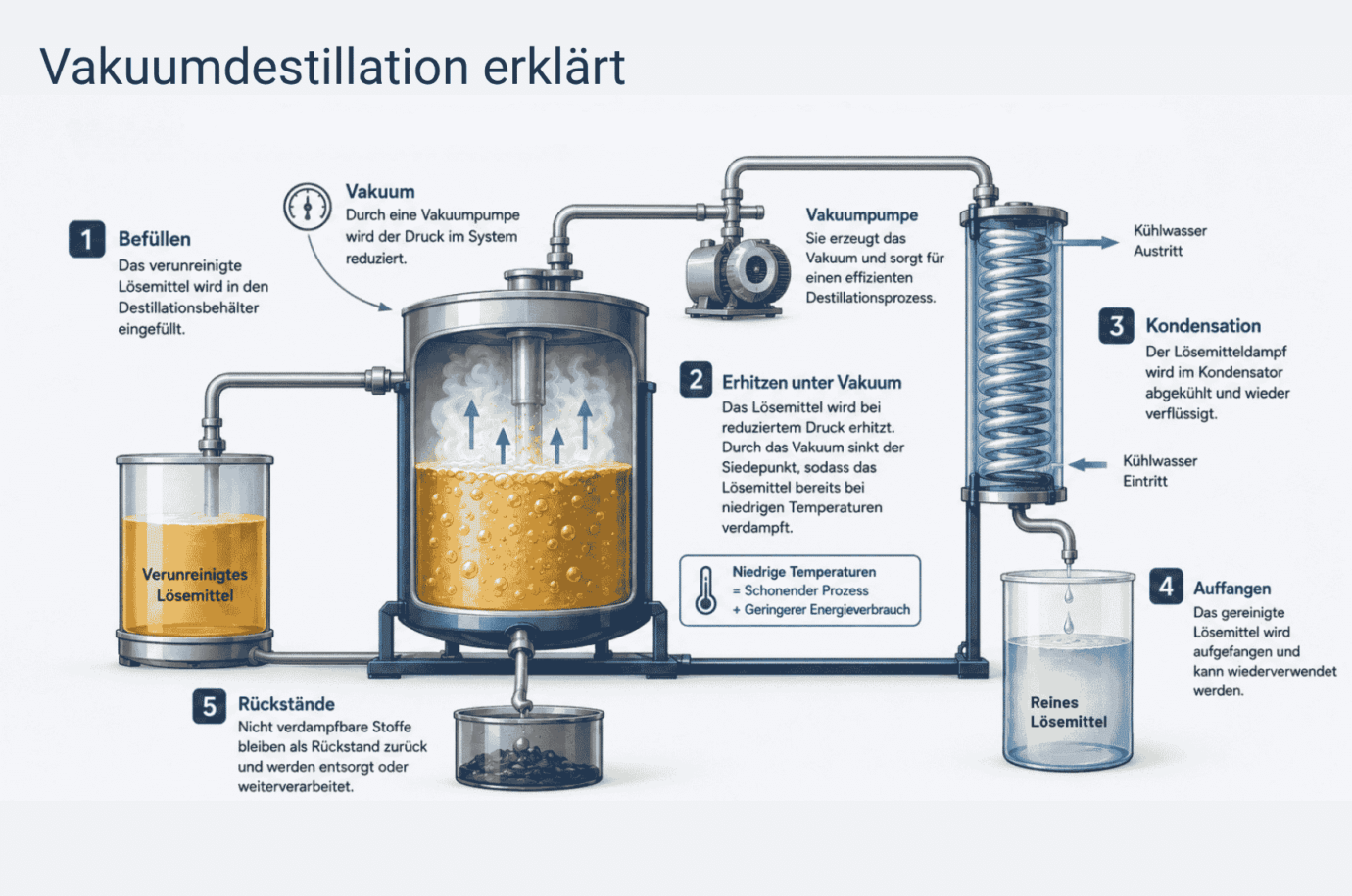
The diagram illustrates the vacuum distillation process in five steps—from filling the vessel with contaminated solvent to collecting the clean distillate.
How Vacuum Solvent Distillation Works and Its Benefits
Why Vacuum Distillation Is Indispensable for Modern Industrial Processes
For many companies, the efficient recovery of solvents has long since ceased to be merely an economic advantage; rather, it has become a key prerequisite for sustainable and legally compliant production processes. Rising raw material prices, stricter environmental regulations, and the desire for a resource-efficient circular economy are leading more and more companies to rely on modern solvent recovery processes.
One of the most important technologies in this field is vacuum distillation. It enables the particularly gentle and cost-effective recycling of used solvents and is used today in numerous industries.
Companies in the printing industry, the paint and coatings sector, surface technology, the chemical industry, and metalworking benefit from the advantages of modern vacuum distillation systems. As one of the world’s leading specialists in industrial solvent recovery, RENZMANN has been developing innovative machines for the sustainable recycling of solvents for decades.
In this article, you'll learn in detail:
- What Is Vacuum Distillation?
- How the Technology Works
- Why it may be superior to traditional distillation
- Which solvents can be recovered
- What economic benefits result?
- Industries in Which Vacuum Distillation Is Used
- Why Modern Distillation Plants Make an Important Contribution to the Circular Economy
What is vacuum distillation?
Vacuum distillation is a thermal separation process used for the treatment and recovery of solvents.
Unlike atmospheric distillation, the process takes place under reduced pressure. The vacuum created causes the boiling point of the respective solvent to drop significantly.
As a result, the solvent can evaporate even at significantly lower temperatures.
This effect offers significant advantages:
- lower energy consumption
- gentler handling of delicate materials
- less thermal stress
- reduced residue formation
Vacuum distillation is therefore particularly well-suited for high-quality solvents as well as for applications that require a high recovery rate.
Why does the boiling point decrease in a vacuum?
The relationship between pressure and boiling point is one of the fundamental physical principles of distillation.
The vapor pressure is the key factor determining a solvent’s boiling properties. This property of a solvent depends on the temperature of the substance. As the temperature rises, the vapor pressure increases. When the temperature reaches a point at which the solvent’s vapor pressure exceeds the ambient pressure, the solvent begins to boil. We call this point the boiling point. In vacuum distillation, we take advantage of this basic principle of vapor pressure by reducing the ambient pressure of the solvent, thereby reducing the temperature increase required to reach the vapor pressure necessary for boiling.
The examples show the normal boiling point at atmospheric pressure compared to the boiling point under a vacuum at 100 mbar absolute:
| Solvent | Normal boiling point | Boiling point at 100 mbar absolute |
| Acetone | 56 °C | < 1°C |
| Butyl acetate | 126°C | < 62°C |
| Ethanol | 78 °C | < 29°C |
| Isopropanol | 82 °C | < 33°C |
| Ethyl acetate | 77 °C | < 20°C |
| Toluene | 111 °C | < 45°C |
| Xylene | 138–144 °C | < 70°C |
The actual boiling temperature depends on the vacuum level achieved. Modern vacuum distillation systems can lower the boiling point of many solvents by more than 50 °C below their normal boiling point.
Thanks to the lower temperatures, solvents can be gently recovered without causing thermal damage to sensitive components.
How does vacuum distillation work?
Vacuum distillation consists of several precisely coordinated process steps: loading, creating a vacuum, evaporating the solvent, condensation, and draining or emptying.
1. Filling the distillation unit
The contaminated solvent is poured into the distillation kettle. Typical contaminants include: paints, varnishes, printing inks, resins, oils, greases, adhesives, and polymer residues
The composition depends on the specific application.
2. Creating the vacuum
A vacuum pump is used to reduce the pressure in the distillation vessel. Different vacuum levels are set depending on the process. The reduction in pressure significantly lowers the boiling point of the solvent. As a result, evaporation begins much earlier than in conventional distillation.
3. Evaporation of the solvent
The solvent is heated in a controlled manner. Since its boiling point is lower, comparatively low temperatures are sufficient. The volatile components evaporate. Non-volatile substances remain in the distillation vessel.
4. Condensation
The solvent vapor enters a condenser, where it is cooled. The vapor condenses back into a liquid and is collected as clean solvent. This distillate can often be reused directly in the production process.
5. Removal of Residues
Once the distillation process is complete, concentrated residues remain in the distillation vessel.
Depending on their material composition, these are disposed of, reprocessed, or thermally recycled.
RENZMANN's state-of-the-art systems enable highly efficient residue removal and minimize maintenance requirements.
Why is vacuum distillation better than conventional distillation?
Many companies wonder whether using a vacuum distillation system is economically viable. In most industrial applications, the answer is a clear yes.
Lower process temperatures
The most important advantage is the lower temperatures.
This results in:
- Products are protected
- Reduced Load on Facilities
- Reduced energy costs
Higher-quality solvents
Less thermal stress means:
- fewer byproducts
- higher purity
The recovered solvent can often reach a quality level nearly equal to that of fresh solvent.
Less residue buildup
At high temperatures, residues may harden.
Vacuum distillation significantly reduces this effect.
As a result, the following decrease:
- Cleaning effort
- Downtime
- Maintenance Costs
Higher recovery rates
Modern vacuum distillation plants often achieve recovery rates of over 95 percent.
This significantly reduces the need for new materials.
Which solvents can be recovered using vacuum distillation?
The technology is suitable for a wide range of organic solvents.
Examples include:
Alcohols
- Ethanol
- Isopropanol
- Methanol
Ketones
- Acetone
- MEK (methyl ethyl ketone)
- MIBK
Esther
- Ethyl acetate
- Butyl acetate
Hydrocarbons
- Toluene
- Xylene
- Test Gasoline
Specialty Solvents
- Printing Solvent
- Cleaning media
- Process solvents
Which substances can be distilled economically depends on the specific process requirements.
What are the applications of vacuum distillation?
Printing Industry
The printing industry is one of the largest users of solvent recovery systems worldwide.
Printing inks often contain: ethyl acetate, ethanol, or isopropanol
These can be efficiently recovered.
RENZMANN has decades of experience, particularly in the field of printing applications.
Flexographic Printing
Large amounts of solvents are used in flexographic printing.
Vacuum distillation can be used to produce detergents, paint thinners, and cleaning agents
be reused.
gravure printing
Gravure printing also produces significant amounts of solvents.
In this context, recycling enables significant savings in purchasing and waste disposal.
Paint and Coatings Industry
Paints often contain high-quality solvents.
Recovery reduces raw material consumption, CO₂ emissions, and overall operating costs.
Automotive Industry
Large quantities of contaminated solvents are generated in paint shops and manufacturing processes.
Vacuum distillation ensures cost-effective reuse, consistent quality, and lower disposal costs.
Chemical Industry
Chemical production processes often use expensive specialty solvents.
Recovery significantly improves cost-effectiveness.
Metalworking
Degreasing and cleaning processes often use solvents that can be recovered through vacuum distillation.
What are the economic benefits of solvent recovery?
Reduced solvent costs
The greatest savings come from the reduced need for fresh solvents.
Many companies are reducing their procurement costs by a factor of several times.
Lower disposal costs
Solvent waste is among the most costly types of hazardous waste.
Recycling significantly reduces the volume of waste.
Faster Payback
Depending on the volume of use, modern distillation systems often pay for themselves within just a few years. The average payback period for Renzmann’s ROTOmaX distillation system is just 1.5 years.
More stable supply chains
Reusing our own solvents reduces our dependence on raw material markets. This is becoming increasingly important, especially in times of price volatility.
Sustainability Through Vacuum Distillation
Industrial sustainability is becoming a strategic factor for companies worldwide.
Vacuum distillation supports numerous environmental goals.
Lower resource consumption
Every kilogram of solvent that is recovered does not have to be produced again.
This helps conserve raw materials.
Reduction of CO₂ emissions
The production of new solvents consumes energy.
Reuse reduces indirect emissions.
Support for the Circular Economy
Recovery is a classic example of a circular economy in action.
Materials remain in the economic cycle longer.
Compliance with Legal Requirements
Companies are facing increasing regulatory pressure. Vacuum distillation helps them comply with environmental regulations, waste management laws, sustainability strategies, and, consequently, their ESG goals.
What does vacuum distillation have to do with safety?
Solvents are often flammable. That is why safety and explosion protection are at the heart of Renzmann’s machine designs.
Depending on the flash point of the solvents used, Renzmann installs only liquid-jet vacuum pumps. These pumps use a nozzle system based on the Venturi principle. As a result, this type of pump can generate a vacuum in the distillation unit entirely without any moving parts in the hazardous area. Regardless of the temperature and flow rate of the circulating fluid, these pumps can evacuate the system down to its physical equilibrium without any risk of ignition.
RENZMANN designs its systems in accordance with the highest European safety standards under ATEX. Unlike all other manufacturers, Renzmann designates the interior of its distillation systems as Zone 0. This means that all moving parts inside the still must undergo type testing.
Automation in Modern Distillation Plants
Digitalization is also transforming solvent recovery.
Modern systems offer:
- automatic batch control
- Process Monitoring
- Remote Maintenance
- Data Analysis
- Energy Optimization
This makes processes more efficient and reproducible.
Why choose Renzmann's vacuum distillation?
For decades, RENZMANN has been one of the leading manufacturers of industrial solvent recovery systems.
The company's solutions are characterized by:
- high recovery rates
- energy-efficient technology
- The highest possible level of protection according to ATEX (compared to all other standard providers on the market). The strict ATEX design, with consistent certification of all moving parts inside the still as Category 1 equipment for operation in Zone 0—read more about it here.
- sturdy construction
- international experience
- comprehensive service
- Customized solutions
Customers around the world rely on RENZMANN's expertise in developing sustainable and cost-effective distillation systems.
The Future of Vacuum Distillation
The demands placed on industrial companies will continue to rise.
Trends such as rising raw material prices, stricter environmental regulations, decarbonization goals, the promotion of the circular economy, and ESG reporting will continue to drive up demand for efficient solvent recovery. Modern vacuum distillation systems play a key role in supporting sustainable industrial production.
Conclusion: Vacuum distillation is the key to efficient solvent recovery
Vacuum distillation is one of the most efficient methods for processing and recovering solvents today. By lowering the pressure, solvents can be vaporized at significantly lower temperatures. This protects the products, reduces energy consumption, and enables high recovery rates.
Companies quickly benefit from lower raw material costs, lower disposal costs, greater process reliability, improved sustainability, and greater independence from raw material markets
With innovative systems and decades of experience, RENZMANN helps companies worldwide recover solvents cost-effectively and implement sustainable production processes.
Press contact:
Renzmann GmbH
Marketing & Communication Rebecca Wilhelm
E-Mail: wilhelm@dw-renzmann.de
Phone: +49 (0)6751 / 878-290