Efficient distillation for industrial requirements
Distillation unit
ROTO
Wash-out solvent
Washing approaches
Production aids
Dilutions
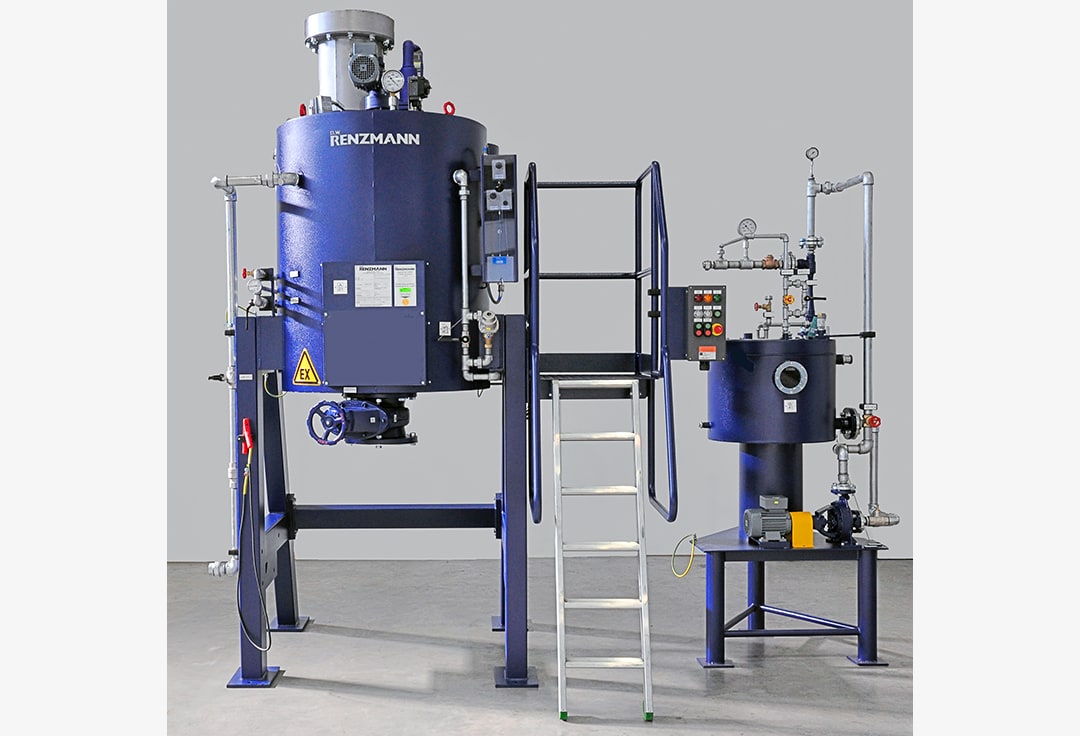
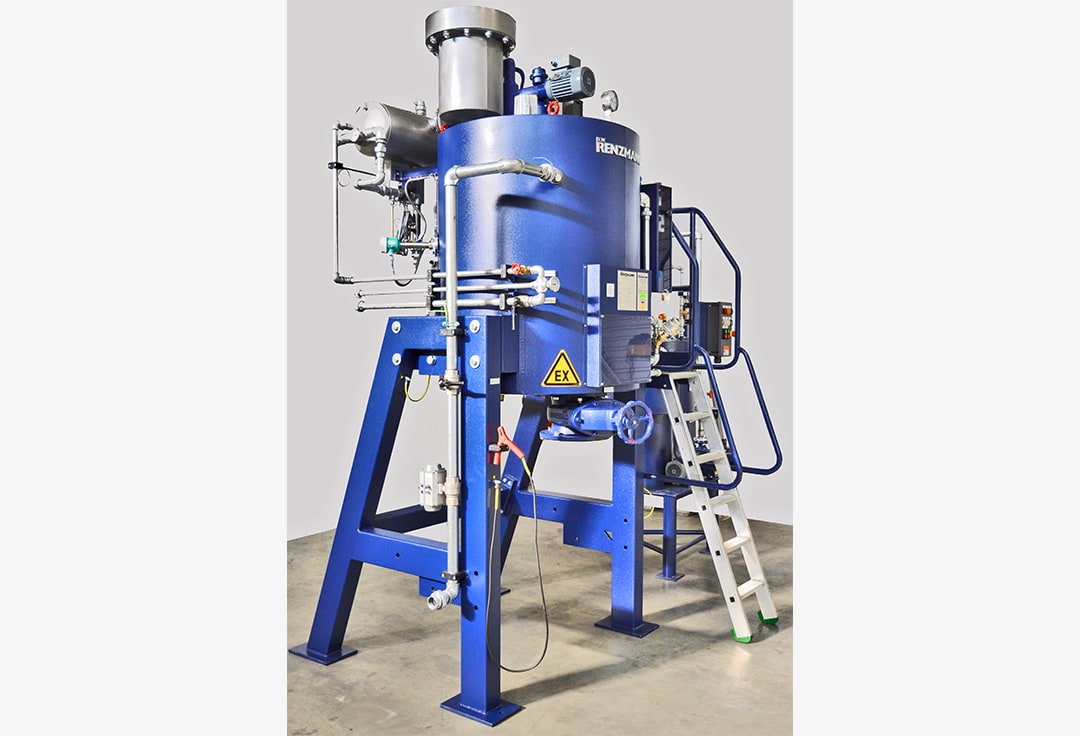
The ROTO offers robust and high-performance distillation unit for the recovery of solvents in industrial processes. Thanks to vacuum-proof stainless steel vessels, intelligent control and versatile heating options, the ROTO is ideal for demanding applications with a wide variety of substances. The modular design and optional components enable precise adaptation to your processes.

Distillery ROTO
Key features

Distillation capacity
- Recovery rate of over 92%* (*depending on type and quantity of solvent)
- Cylindrical, vacuum-proof distillation kettle made of stainless steel for more homogeneous heat distribution and constant thickening
- Water-cooled condenser made of stainless steel for reliable recondensation
- Agitator with scrapers (rotor) prevents caking and ensures even mixing
- Insulated heating jacket with built-in heating elements (optional thermal oil or water heating)

comfort
- Automatic termination of the filling process by vibration level switch and pneumatic ball valve
- Manually or pneumatically operated, dirt-resistant drain valve
- Ex halogen lamp and sight glass for observing the process
- Ex operating elements for controlling vacuum, filling, heating, rotor and emergency stop
- Programmable logic controller (PLC) with display for displaying and entering process parameters
- Batch or continuous operation possible
- Discharge height adapted to waste disposal container and/or 200 l drum (standing on pallet) (with ROTO 9 as accessory), standard discharge height 650 mm

Security
- Explosion protection in accordance with ATEX, category 1 (with type examination) for zone 0 inside, category 2 for zone 1 outside the machine
- Vakuumeinheit mit Flüssigkeitsstrahlpumpe für Lösemittel mit niedrigem Flammpunkt (< 55 °C) ODER Vakuumeinheit mit Flüssigkeitsringpumpe für Lösemittel mit hohem Flammpunkt (> 55 °C)
- System on stable frame with safe access and observation platform (optional for ROTO-9)
- Robust design with high-quality components (pumps, fans) for a long service life
Do you need more?
Get the most out of your machine with the right accessories. Simplify your processes and improve process reliability, working comfort and distillation performance - individually tailored to your requirements and industry standards.
Cleaning result
- Distillation capacity monitoring for automatic shutdown if the minimum capacity is not reached
- Sump temperature monitoring for temperature-sensitive substances
comfort
- Time control for automatic start of the distillation process
- Backlog trolley (only ROTO available for 9)
- Sealing plate/cover for customer disposal containers
Process reliability
- Vacuum unit, optionally with liquid ring or liquid jet vacuum pump for safe and gentle distillation of sensitive media
- Sealing plate with integrated suction
- Thermostatic valves for connection to external cooling/city water networks or separate cooling units
Further information
All details at a glance: Download the product flyer or send us your request for an individual consultation.
Our ATEX protection concept
Others promise, Renzmann delivers safety
Conclusion
The ROTO series from RENZMANN provides you with a safe, powerful and versatile solution for efficient solvent recovery. The high-quality workmanship and the use of reliable components from Germany or the EU guarantee a long availability of spare parts. Contact us for a personal consultation and an individual offer!
FAQ Sales
All categories
What does Industrial IoT mean for purification and distillation plants?
Industrial IoT (IIoT) refers to the intelligent networking of machines, systems, and digital services. For cleaning and distillation systems, this enables secure access to relevant operating data as well as efficient support from the service team.
Connectivity enables operators to analyze machine conditions, diagnose malfunctions more quickly, and make targeted technical adjustments. This helps operators increase plant availability, reduce unplanned downtime, and make service calls more efficient.
Using Renzmann’s remote access solution, service technicians can, for example, check machine parameters, optimize exhaust air control settings, diagnose frequency converters, or monitor the load cell electronics of ROTOmaX distillation systems. At the same time, on-site employees can receive targeted support with troubleshooting and problem-solving.
Industrial IoT thus lays the foundation for modern, connected manufacturing in line with Industry 4.0 and enables greater process reliability, equipment availability, and service quality.
What recovery rates can be achieved?
The ROTOmaX is our most efficient machine when it comes to solvent recovery. Depending on the solvent and the degree of contamination, it achieves a recovery rate of up to 97%. Intelligent load cell technology and a high degree of automation make the machine significantly more efficient than comparable machines from other manufacturers.
For what levels of contamination is the ROTOmaX suitable?
The ROTOmaX was specifically designed for heavily contaminated solvents, washing media, and solutions containing production-related residues. The rotor and scraper system prevents buildup and ensures reliable operation even when solid content is high.
Can the ROTOmaX be used in both batch and continuous operation?
Yes. The ROTOmaX is designed for industrial solvent recovery in both batch and continuous operation. This allows the distillation unit to be flexibly adapted to different production processes, solvent volumes, and levels of contamination.
In batch mode, a defined quantity of contaminated solvent is processed. This operating mode is particularly suitable for companies with fluctuating solvent flows, different production batches, or varying residues from printing inks, paints, coatings, and other chemical processes.
For applications involving a constant stream of solvent-containing production waste, the ROTOmaX offers the option of continuous solvent treatment. In this process, the contaminated medium is fed into the system continuously, while the treated solvent is recovered on a continuous basis. This enables particularly cost-effective solvent recovery during continuous operation and high throughput rates.
Thanks to its proven rotor and scraper system, the unit reliably processes even heavily contaminated media with high solids content. When combined with the optional vacuum technology, the ROTOmaX is suitable for numerous applications in solvent treatment, solvent recycling, and vacuum distillation of solvents in the printing, coatings, packaging, and chemical industries.
What sets the ROTOmaX apart from other solvent distillation systems in terms of explosion protection?
All Renzmann distillation systems are ATEX-certified and classified as Category 1 equipment for Zone 0 inside the distillery, and Category 2 for Zone 1 outside the distillation system.
While RENZMANN generally classifies the interior of the boiler as Zone 0, some competitors classify this area only as Zone 1. To the operator, this difference may initially seem purely theoretical. In fact, however, it has significant implications for the safety of the system and the required inspections.
Classification as Zone 0 has a direct impact on the plant’s design: components inside the distillation kettle that could serve as potential ignition sources—such as agitators or level switches—are then subject to significantly stricter requirements and must be type-tested. These tests incur costs.
If, on the other hand, the interior of the boiler is classified only as Zone 1, many of these requirements can be reduced. This makes the development, testing, and certification of the system significantly less expensive.
However, in RENZMANN’s view, safety considerations must not be subordinated to economic considerations. For this reason, the company adheres to the strictest available regulations and evaluates actual operating conditions rather than the minimum design requirements.
You can find a detailed explanation of our ATEX safety concept here.
How is the fill level monitored?
The ROTOmaX uses load cells for continuous weight measurement. This allows for precise monitoring of the fill volume, distillate volume, and residue volume. Actual performance data can be retrieved thanks to load cells that measure productivity. More data provides the opportunity to tailor the distillation process more precisely to your specific application. Other manufacturers do not offer any means of productivity analysis, which significantly compromises process control and efficiency.
Why is a rotor or scraper system used?
The stirring and scraping mechanism in the ROTOmaX keeps the distillate constantly in motion, preventing deposits and caking on the heating surfaces, thereby improving heat transfer and increasing efficiency. During draining, the scraping mechanism runs in reverse and assists in the automatic discharge of residues through a DN 200 outlet. Thanks to the larger outlet, we can concentrate the distillate even more than other manufacturers. The stirring and scraping mechanism is made of low-maintenance bronze contact scrapers and is therefore very durable.
Does the ROTOmaX require a full-time operator or constant operator supervision?
No. The ROTOmaX was designed for largely automated operation and does not require constant operator supervision. In particular, the ROTOmaX Automation can be started automatically using timer functions and carries out the distillation process on its own.
During operation, the system automatically monitors the relevant process parameters. The operator does not need to be present at the machine at all times. As soon as intervention is required—for example, when the residue container needs to be replaced—the system alerts the staff with a corresponding signal.
As a result, industrial solvent recovery does not require a full-time operator. In many facilities, the ROTOmaX is operated by employees who also perform other tasks. These include, for example, cleaning printing unit components, operating a mixing system, packaging activities, or logistical tasks within the production process.
Automated process control significantly reduces labor costs and enables cost-effective solvent treatment even with limited staff resources. Companies benefit from efficient solvent recovery without having to allocate additional specialized personnel solely for the operation of the distillation plant.
The ROTOmaX is therefore an attractive solution for automated solvent recovery, particularly in the printing, packaging, coating, and chemical industries, offering low operational requirements and high system availability.
How much residue is left after distillation?
That depends on the composition of the feedstock. Typically, only a highly concentrated, paste-like residue remains. As a result, operators incur only minimal disposal costs. At the same time, you save money because you need to purchase less fresh solvent.
Highly efficient thickening is made possible by the built-in load cell technology and an intelligent stirring and scraping mechanism that prevents buildup on the heating surfaces. This ensures optimal heat transfer. The geometry of the distillation kettle is also a key factor in this process. The flat bottom and larger diameter allow for better concentration. Higher concentration also means a higher recovery rate. You can also see in this video just how viscous the discharge can be with our ROTOmaX.
What kinds of problems can be diagnosed via remote maintenance?
What kinds of problems can be diagnosed via remote maintenance?
Remote Access allows users to monitor and analyze numerous machine functions. These include, among other things, exhaust air control settings, diagnostics for variable-frequency drives used for speed control, monitoring of load cell electronics in ROTOmaX distillation systems, and general machine and process parameters.
This allows the causes of errors to be identified more quickly and provides operators with targeted support in troubleshooting malfunctions.
Can solvents with a high boiling point also be recycled?
Yes. The ROTOmaX is also suitable for processing high-boiling-point solvents and offers the most cost-effective method for solvent recovery at high boiling points. Vacuum technology lowers the boiling point of the medium, allowing distillation to take place at significantly lower temperatures.
This offers significant advantages when processing temperature-sensitive solvents, complex solvent mixtures containing nitrocellulose, and media used in the printing, paint, coating, and chemical industries. Gentle vacuum distillation of solvents reduces thermal stress, minimizes product degradation, and simultaneously lowers the energy requirements of the distillation process.
Thanks to this technology, the ROTOmaX is suitable for a wide range of applications in industrial solvent treatment, solvent recycling, and the recovery of high-boiling-point solvents. This allows even challenging media to be efficiently treated and returned to the production process.
How do I get a quote?
It's easy to get a quote: Contact us by email at sales@dw-renzmann.de or call us on +49 (0) 6751 878-0. Together, we will analyze your needs - e.g. which parts you want to clean or which solvent you want to treat - and prepare a tailor-made offer for you.
Who is my contact for advice and technical questions?
Our sales staff will support you with their in-depth specialist knowledge. In addition, the sales staff work closely with our technical center so that application tests can also be carried out if required.
Who is responsible for my country or region?
We have a worldwide sales network. You can find the contact person responsible for your region here. Alternatively, our sales team will be happy to help you directly and put you in touch. For customers in Germany (and selected other countries), sales are handled directly by our company headquarters in Monzingen.
What information does Renzmann need for an initial assessment?
We need some basic information to provide targeted advice: What is to be purified or distilled? In what quantities? How heavy is the contamination? Are there special geometries or requirements for the cleaning or recovery result? Describe your task to us by e-mail. We will then be happy to send you the appropriate questionnaire. Based on this query, we can create a customized concept for your application.
Which distillation system is right for my application?
Our consultation begins with a personalized assessment of your requirements and needs. You describe your requirements to us—for example, the solvents you use—and we recommend the right machine for you. For more complex requirements or if you have any uncertainties, we offer washing or distillation trials at our technical center. This allows you to see under real-world conditions which system is best suited for you. You can request an appointment for a washing or distillation trial directly here.
How does distillation work?
Distillation is a separation process used to separate mixtures of liquids or to extract a liquid from a solution. It takes advantage of the different boiling points of the substances present.
The mixture is heated. The component with the lower boiling point evaporates first and rises as vapor. This vapor is cooled in a condenser and condenses back into a liquid. The condensed liquid (distillate) is collected in a receiving flask. Substances with a higher boiling point remain in the flask.
Distillation Process
- Heating the liquid mixture
- Evaporation of the component with the lower boiling point
- Condensation of steam in the cooler
- Collecting the distillate in the receiving vessel
Important: Distillation is particularly suitable for separating liquids with significantly different boiling points.
What is solvent distillation?
Solvent distillation is a separation process in which a solvent is vaporized by heating and then liquefied again through condensation. In this process, the solvent is separated from dissolved substances or impurities.
Operating principle
- A solution is heated.
- The solvent (e.g., water, ethanol, acetone) evaporates because of its lower boiling point.
- The steam is cooled in a condenser.
- The condensed solvent is collected.
- Non-volatile substances remain in the distillation flask.
Applications
- Solvent Recovery in the Chemical Industry
- Cleaning, purification, and recycling of used solvents
- Separation of products based on chemical reactions
- Environmental protection, since solvents can be reused instead of being disposed of
Example
A paint factory uses acetone to clean its equipment. The used acetone contains paint residues. Through solvent distillation, the acetone is vaporized and condensed, while the paint residues remain behind. The purified acetone can then be reused. Only the paint residues need to be disposed of.
Advantages
- Saves costs by reusing the solvent
- Reduces waste
- Enables high levels of purity
In short: Solvent distillation is used to separate and recover a solvent by evaporating and condensing dissolved substances or impurities.
Which industries benefit from solvent recovery?
In general, all industries that use solvents benefit from solvent recovery. Recycling reduces costs by minimizing the need to purchase expensive new solvents. Solvent recovery also allows companies to implement or expand circular economy practices within their own operations. Specifically, the following industries regularly use solvents: printing, paint and coatings manufacturers, chemicals, automotive, plastics, pharmaceuticals, textiles and leather, optics and glass, electronics, metals, and others.
At what point does a distillation plant become economically viable?
A distillation unit is worthwhile even when only very small amounts of solvent are generated. This is the case, for example, with manufacturers of flexographic printing plates. The wash-off solvent generated during the production of printing plates is ideal for recovery in an in-house distillation unit.
For very expensive solvents, a distillation unit can be cost-effective starting at 20 tons per year. On average, purchasing your own DW-type machine makes sense starting at 50 tons per year.
We would be happy to provide you with personalized advice. You can contact our sales team here.
What is the difference between solvent disposal and solvent recovery?
The primary goal of solvent disposal is to ensure that contaminated solvents are disposed of properly. This is costly and time-consuming in two ways: Businesses that use solvents need them on a regular basis and must therefore continually purchase fresh solvents. They are dependent on service providers and rising raw material prices. They must maintain large stocks of clean solvents, which incurs storage and handling costs. The disposal of contaminated solvents is also very expensive.
On the other hand, having your own in-house solvent recovery system is almost always worthwhile. Solvent recovery is carried out using a distillation unit that is tailored to your solvent volumes, the type of solvent, and your production process. Through the separation process involved in distillation, it allows for the recovery of a large proportion of clean solvent. Ideally, only a small amount of material remains to be disposed of. We would be happy to calculate your return on investment (ROI). Contact our sales team here.
What is the return on investment (ROI) of my distillation plant?
The average return on investment for our ROTOmaX, for example, is less than 1.5 years. For our ROTO distillation plant, the average ROI for 30 tons of ethanol per year is 1.8 years. We would be happy to calculate your exact ROI based on your specific data (labor, heating, and disposal costs, as well as operating hours, etc.). For a precise calculation, please contact our sales team at vertrieb@dw-renzmann.de.
Which solvents can be recovered using a distillation unit?
In general, our distillation units can distill any solvent with a boiling point under vacuum of less than 180 degrees.
These include, for example: 1,3-dioxolane, 1-ethoxy-2-propanol, 1-methoxy-2-propanol, 2-ethylhexanol, 2-ethylhexyl acetate, 3-methoxy-3-methylbutan-1-ol, acetone, benzyl alcohol, butanol (-n-), butyl acetate, butyldiglycol, butyl glycol, butyl glycol acetate, cyclohexyldiethanolamine, decahydronaphthalene, decane, diacetone alcohol, diethanolamine, diethylene glycol, diethylene glycol monomethyl ether, dimethylacetamide, DMF, DMM, DMPU, DMSO, dodecane, DPM, ethanol, ethanolamine, ethyl acetate, ethylene glycol, ethyl lactate, heptane, hexane, IPA, MEK, methanol, methyl acetate, methylcyclohexane, MIBK, N-methylformamide, NMP, phenoxyethanol, PMA, propanediol, propanol (-n-), propyl acetate (-i-), propyl acetate (-n-), styrene, tetrachloroethane, tetradecane, toluene, TOU, tridecane, undecane, xylene (mixture of isomers), xylene (-m-), xylene (-o-), dipropylene glycol monobutyl ether, p-cymene
However, our ROTOmaX can also purify aqueous solutions. Please feel free to contact us for a comprehensive consultation: vertrieb@dw-renzmann.de
What is the solvent recovery rate?
The exact recovery rate for solvent distillation depends heavily on the type of solvent and the degree of contamination. Depending on the solvent, our smallest distillation unit (Model M) achieves a recovery rate of 85%, while our largest distillation unit (ROTOmaX) achieves a recovery rate of up to 97%.
We offer our customers the opportunity to have their original contaminated solvent distilled on a trial basis at our in-house technical facility. This allows you to see for yourself the exact recycling rate. In any case, you will receive a detailed report and, upon request, samples for analysis by your own experts.
How much does a distillation unit for solvent recovery cost?
The cost of a solvent recovery distillation system depends primarily on the required processing capacity, the solvents used, the degree of contamination, and the desired level of automation.
For applications in the paint, coatings, and printing industries, the initial investment costs for smaller systems often start in the mid- to high-five-figure range. Industrial distillation systems designed for larger volumes of solvents or complex solvent mixtures can cost over 200,000 euros, depending on the model.
However, when assessing cost-effectiveness, it is important to consider more than just the initial purchase price. By recovering and reusing solvents, companies can significantly reduce their disposal and procurement costs. Our distillation units have an average return on investment (ROI) of about 1.5 years, which can be attributed in part to their high recovery rates.
For an accurate price quote, we recommend a custom design based on the volume of solvents to be processed and your specific process requirements. We would be happy to provide you with a customized quote for your application.
We also offer to distill your original contaminated solvents on a trial basis in our in-house technical laboratory . This allows you to see the efficiency for yourself and back up your investment with reliable data.
What industries are these machines designed for?
Renzmann has decades of experience in developing solutions and collaborating with customers in the printing, packaging printing, and ink and coating manufacturing sectors. However, the machines are not limited to these industries. Renzmann also has numerous customers from the automotive sector, the chemical industry, the plastics industry, the optics and glass industry, the pharmaceutical industry, the textile and leather industry, the coatings industry, and many others. High-precision engineering also makes custom solutions and custom-made products possible. Please feel free to contact us at vertrieb@dw-renzmann.de
What special solutions are possible?
Our machines are based on proven technology, but can be adapted to customer-specific requirements at additional cost. These include, for example, special adapter systems, control concepts suitable for integration, adaptations to structural conditions or special process-related functions. Simply contact us - together we will check what is technically feasible and economically viable.
Does Renzmann also offer international deliveries?
Yes, we deliver worldwide and have decades of experience in the production of machines for the international market. Our machines meet country-specific requirements, both in terms of technical standards and regulations as well as documentation. Our local sales partners also support you with communication and project management.
How quickly can I expect an offer?
Generally, you will receive your quotation within a few working days. More complex projects that require technical consultation or trials in the technical center may take a little longer. We will keep you informed of the status in a transparent manner. Request a quote.
How does Renzmann position itself when it comes to safety?
We supply ATEX-compliant machines for operation with flammable solvents. This is based on Directive 2014/34/EU (current version) and the associated guidelines of the EU Commission. With our distillation units, however, we go one step further than other suppliers. Unlike other manufacturers, we define Zone 0 inside our distillation units. This means that, in addition to all electrical devices, all moving mechanical parts inside the distillation bubble are also type-tested and approved for permanent operation in Ex Zone 0. You can find out more under "Our ATEX protection concept".
How does Renzmann position itself when it comes to sustainability and environmental protection?
Sustainability is not an add-on for us, but part of our technology philosophy: our distillation units allow for the recovery and reuse of solvents, thereby reducing disposal costs and resource consumption. Our washing machines are designed so that cleaning media can be used efficiently and processes can be designed to conserve resources. The durability of our machines also contributes to the environmental footprint.
Can I test Renzmann's machines?
Some of our machines for washing and distillation tests are available in our technical center in Monzingen. You can experience them live during a test with your own materials. Alternatively, we will be happy to send you technical documentation or reference reports - we can also organize a digital viewing appointment on request. You can find out more about our technical center here.
WE ARE HERE FOR YOU
If you need technical details about our machines or individual advice -
We will be happy to help you!